Perimenopause: Hormone levels? Who cares!
Every woman I know, who thinks they’re perimenopausal, says the same thing – they went to their doctor, the doctor ordered labs to check their hormone levels, and the levels came back within “normal range,” so that was that. No next steps. No support.
Here’s the thing ladies – hormone levels are not how you diagnose perimenopause.
So why are doctors checking them? How is it that over half the population goes through a hormonal transition that impacts every system in their body, and their healthcare providers don’t know how to diagnose it? I know women’s health has always taken a backseat, in research and drug development. Even crash test dummies are built like men. But it’s been, forever. Literally.

I’m not an anthropologist but I think it’s safe to say that for as long as human beings have existed, females have gone through two hormonal transitions. One on their way to “womanhood.” One on their way to menopause. That’s hundreds-of-thousands-of-years and up until 25 years ago there wasn’t even a standard way to diagnose the second transition.
If every single man on planet earth went through a transition that effected every part of their body, you can bet damn sure every healthcare provider would know how to recognize the earliest signs and know every treatment option available on the market – which there would be a lot of.
Here’s what I don’t understand though, there is a standard now. Some version of it is recognized by respected medical bodies around the globe but only 20% of ob/gyn residencies offer menopause training(1), so imagine if you are not an ob/gyn resident.
The O.G. perimenopause framework was developed at The Stages of Reproductive Aging Workshop (STRAW), in 2001. Twenty-seven participants with extensive experience in the aging female reproductive system gathered in Park City, Utah. The goal of the workshop was to define the different stages of female reproduction and develop common language to describe them. These are the stages STRAW developed, now considered “the gold standard for characterizing reproductive aging through menopause.”:
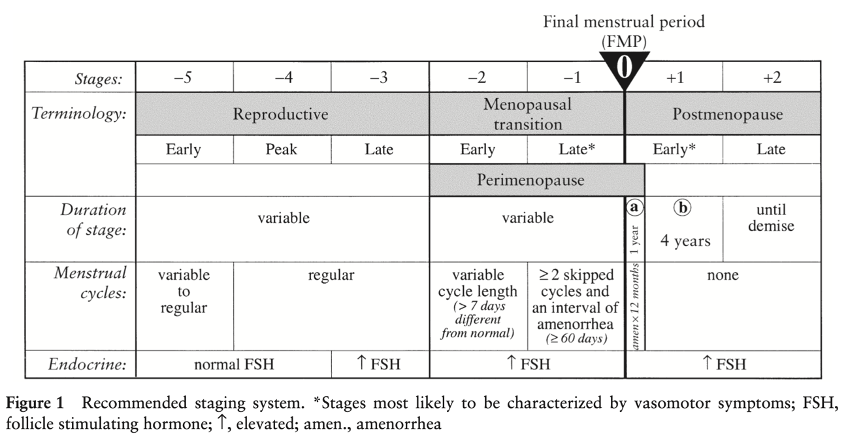
Ten years later, STRAW reconvened to discuss how the research around the hypothalamic-pituitary-ovarian function before and after menopause might impact the STRAW stages.
The results were published as the STRAW+10. This updated system simplified the bleeding criteria for the perimenopause stages, added information about the duration of different stages.

Beyond STRAW, there’s The European Society of Endocrinology Clinical Practice Guideline which was developed so that all “health care professionals have a fundamental knowledge of managing women presenting with symptoms related to the menopause.”
Guess when this was published? October 2025. That’s right, less than six months ago!
Since this post is focused on hormone labs in relation to a perimenopause diagnosis, that’s what I’ll share from the Guideline. (If you want to, you can read the whole guideline here.)
Summary of recommendations: Evaluation
R 1.4 We recommend biochemical testing for diagnosis or management of (peri)menopause in women older than 45 years is not necessary. (Good Clinical Practice)
R 1.5 We recommend biochemical testing for the presence of premature ovarian insufficiency (POI) in women under 40 years of age in the presence of menstrual irregularity and/or subfertility and/or vasomotor symptoms; biochemical testing for the presence of perimenopause or menopause can also be considered in women aged 40-45 years. (Good Clinical Practice)

Now at least YOU KNOW the criteria for a perimenopause diagnosis, but how do you get your healthcare provider to give you the help and support you need? STEP ONE:
Track your periods (here are some trackers). To show “variable length that’s persistent” you want to track at least 3 consecutive months.
STEP TWO:
Go to your appointment armed with information. Take your tracker, a list of your symptoms (here’s a comprehensive list), a printout the STRAW+10 summary and the European Guidelines and see if your healthcare provider is willing to listen.
STEP THREE:
If they aren’t willing to listen, find a new provider (good luck with that) or try an e-provider like Winona or MidiHealth – I have no experience with any of these online companies so I can’t make any recommendations.
And before anyone throws stones, I’m sure there ARE knowledgeable healthcare providers out there, but they are really hard to find. Even when you find one who will listen to you, it’s not always great. The first GYN I worked with who would prescribe hormones, she was in such high demand, she could only give me 5 minutes of her time and was impossible to talk to otherwise. I have a new GYN now, who’s great, but she still bases my treatment on my labs, not my symptoms.
I wish you all the luck in the world! I hope this information helps someone, somewhere get the support they need! Let me know how it goes!!


Comments